Why Can Korean Cosmetics Look Different in Europe Than in Korea?
You find your favourite Korean serum in a European store and suddenly notice something: the box looks a little different, there’s some extra text on it, and that bold promise from...

10/8/2026
Article content1. One Product — Two Markets2. Korea Has a Category Called “Functional Cosmetics”3. Why Might the Promises on the Packaging Become More Modest?4. Can the Ingredients Be Different Too?5. Why Does the Packaging Look Different in Europe?6. Does a Product Become “Worse” After Being Adapted for Europe?7. K-beauty Remains K-beauty
You find your favourite Korean serum in a European store and suddenly notice something: the box looks a little different, there’s some extra text on it, and that bold promise from the Korean version has disappeared. Sometimes, even the ingredient list is different.
Your first thought might be: is this really the same product? In fact, the reason is often much simpler: a brand may adapt its product to meet the requirements of the market where it is sold.
Cosmetics in South Korea and the European Union are regulated by different systems. These determine which products can be sold, how they must be labelled, and what claims brands can make about them. That’s why the K-beauty products you see in Seoul won’t necessarily look exactly the same on a store shelf in Europe.
Let’s find out what can be different and why 🧐
One Product — Two Markets
Let’s start with the most important thing: there’s no single answer that applies to all Korean cosmetics.
Sometimes, a brand sells a product with exactly the same formula in Korea and Europe. In other cases, the ingredients, labelling, packaging, or product claims may be adapted for the European market. That’s why you need to look at each product individually.
In the EU, cosmetic products are regulated, among other things, by Regulation (EC) No 1223/2009. It establishes requirements for cosmetic safety, ingredients, and labelling before a product can be placed on the market.
South Korea has its own cosmetics legislation. And there’s one particularly interesting feature when it comes to K-beauty.
Korea Has a Category Called “Functional Cosmetics”
Korean legislation defines a separate category known as “functional cosmetics”. This includes, among other things, products intended for skin brightening, improving the appearance of wrinkles, and protecting the skin from ultraviolet radiation.
That’s why terms familiar to K-beauty fans, such as whitening or wrinkle improvement, have a specific regulatory context in Korea rather than being just marketing phrases.
EU legislation has no direct equivalent to the Korean functional cosmetics category. Instead, a product must meet the definition of a cosmetic product, and its claims must comply with the rules governing cosmetic claims (meaning cosmetics cannot be presented as having medicinal effects, and claims about their benefits must not exaggerate what the product can actually do).
That’s exactly why the wording on Korean packaging cannot always simply be translated word for word and used on the European version.
Why Might the Promises on the Packaging Become More Modest?
Now this is where things get interesting 🙂
The EU has a separate Regulation (EU) No 655/2013 concerning the substantiation of cosmetic claims — in other words, statements about a product’s properties and effects.
It establishes six common criteria: legal compliance, truthfulness, evidential support, honesty, fairness, and informed decision-making.
Put simply, a beautiful promise isn’t enough just because it sounds good.
For example, if a brand talks about the properties of a particular ingredient, that doesn’t automatically mean it can attribute those same properties to the entire product. Such a claim about the finished formula must be properly substantiated. European rules explicitly state that the properties of an ingredient cannot be extended to the finished cosmetic product without appropriate supporting evidence.
Similarly, claims about a product’s effectiveness must not go beyond what the available evidence supports.
That’s why the same product may be presented slightly differently in Korean and European stores. A difference in the description doesn’t necessarily mean a difference in the formula itself — sometimes, it’s simply the way the brand communicates the product’s benefits that changes.
Can the Ingredients Be Different Too?
Yes, they can — but not necessarily.
A brand doesn’t automatically need to create a separate formula just because a product is entering the European market. If the ingredients comply with the requirements of both markets, the same formula can be used in Korea and the EU.
However, every product sold in the EU must comply with European requirements. Therefore, if necessary, the manufacturer may adapt the formula for a specific market.
And here’s an important detail: the label “European version” doesn’t automatically mean “different ingredients”. To understand whether the formulas really differ, it’s worth comparing the current INCI lists of the specific product versions.
So the rule is simple:
different packaging ≠ necessarily a different formula.
Why Does the Packaging Look Different in Europe?
Even when the formula inside is exactly the same, the product may look noticeably different on the outside.
European legislation specifies what information must accompany a cosmetic product. In addition, the language used for certain mandatory information is determined by the legislation of the EU country where the cosmetics are sold to the end consumer.
That’s why you might see an additional label, information in several languages, or a different text layout on imported K-beauty products.
For example, Round Lab Birch Juice Moisturizing Sun Cream has different packaging labels for the global and European markets. The global version features the familiar Korean cosmetics designation SPF 50+ PA++++, while the European version displays High Protection SPF 50 and a UVA symbol.
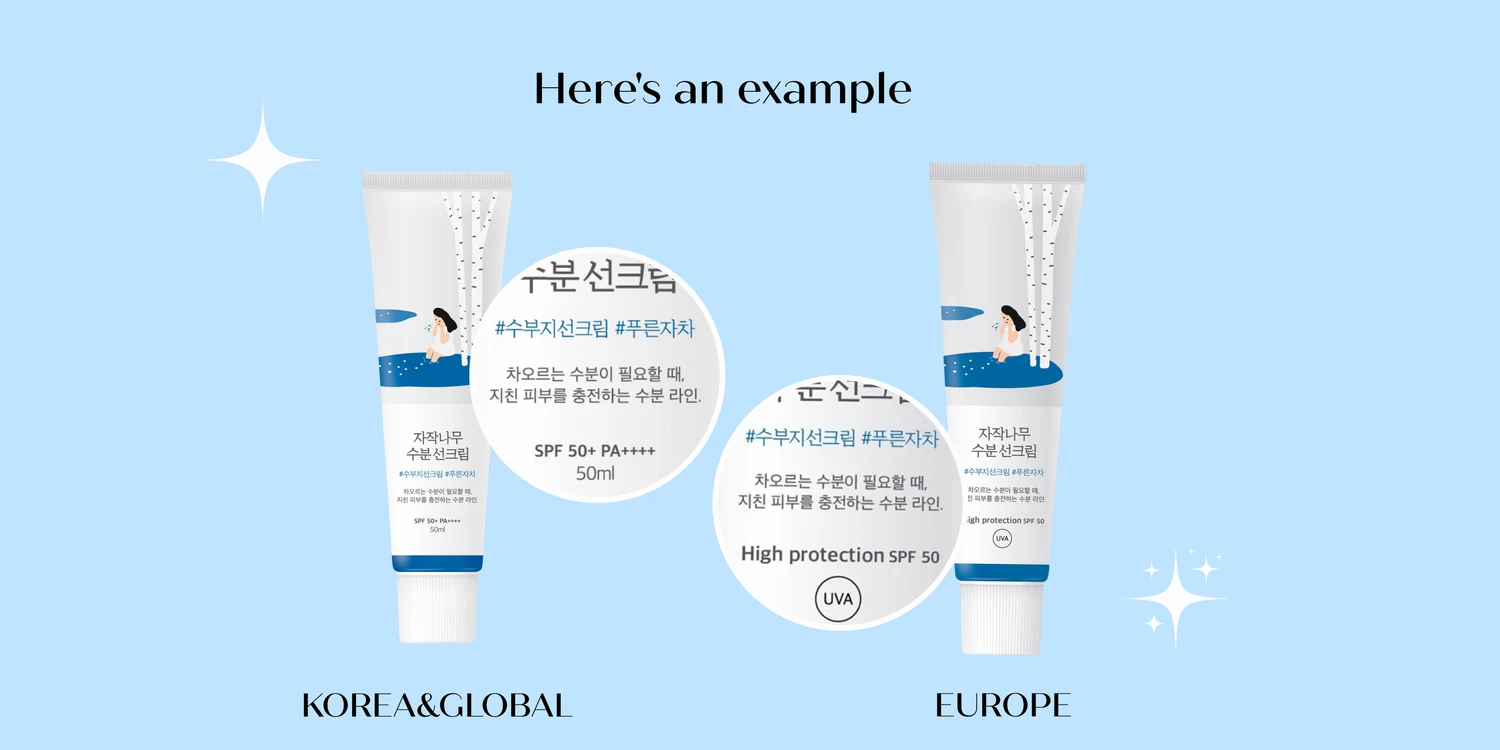
One product — different labelling. This is how ROUND LAB Birch Juice Moisturizing Sun Cream may appear in the global and European markets.
In other words, different packaging doesn’t necessarily mean a different formula. Sometimes, a product is simply adapted to meet the labelling requirements of a particular market.
And that’s why a minimalist Korean box can sometimes become much more “talkative” once it’s prepared for sale in Europe 😅
It’s not necessarily a redesign just for the sake of redesigning — some changes are related to the information required for a specific market.
Does a Product Become “Worse” After Being Adapted for Europe?
No. But it would be equally incorrect to automatically assume that it becomes “better”.
Adapting a product for another market doesn’t, in itself, tell you anything about its quality or effectiveness. First and foremost, it means that the cosmetics must comply with the rules of the country or region where they are sold.
So if your favourite Korean cream has a different box, slightly different wording, or even differences in its INCI list in Europe, that’s not necessarily a reason to suspect a counterfeit.
It’s better to check the current ingredient list of your specific product version, its labelling, and the manufacturer’s recommendations, rather than relying solely on a photo of Korean packaging from TikTok or an old review.
K-beauty Remains K-beauty
When a Korean brand enters the European market, it’s not just a matter of a little jar travelling from Seoul to Paris, Warsaw, or Prague.
There’s also the process of adapting to a different regulatory system: checking the product’s compliance with EU requirements, its labelling, and exactly how the brand describes its properties.
That’s why the Korean and European versions of the same product may be completely identical, or they may have certain differences. There’s no universal rule.
And if you spot a familiar K-beauty product looking a little unfamiliar next time, don’t rush to worry. Maybe it has simply learned to officially speak “European” 😉
This translation is AI-generated, so there might be some minor slip-ups 😌
Did you like the article?
support the author
1 likes